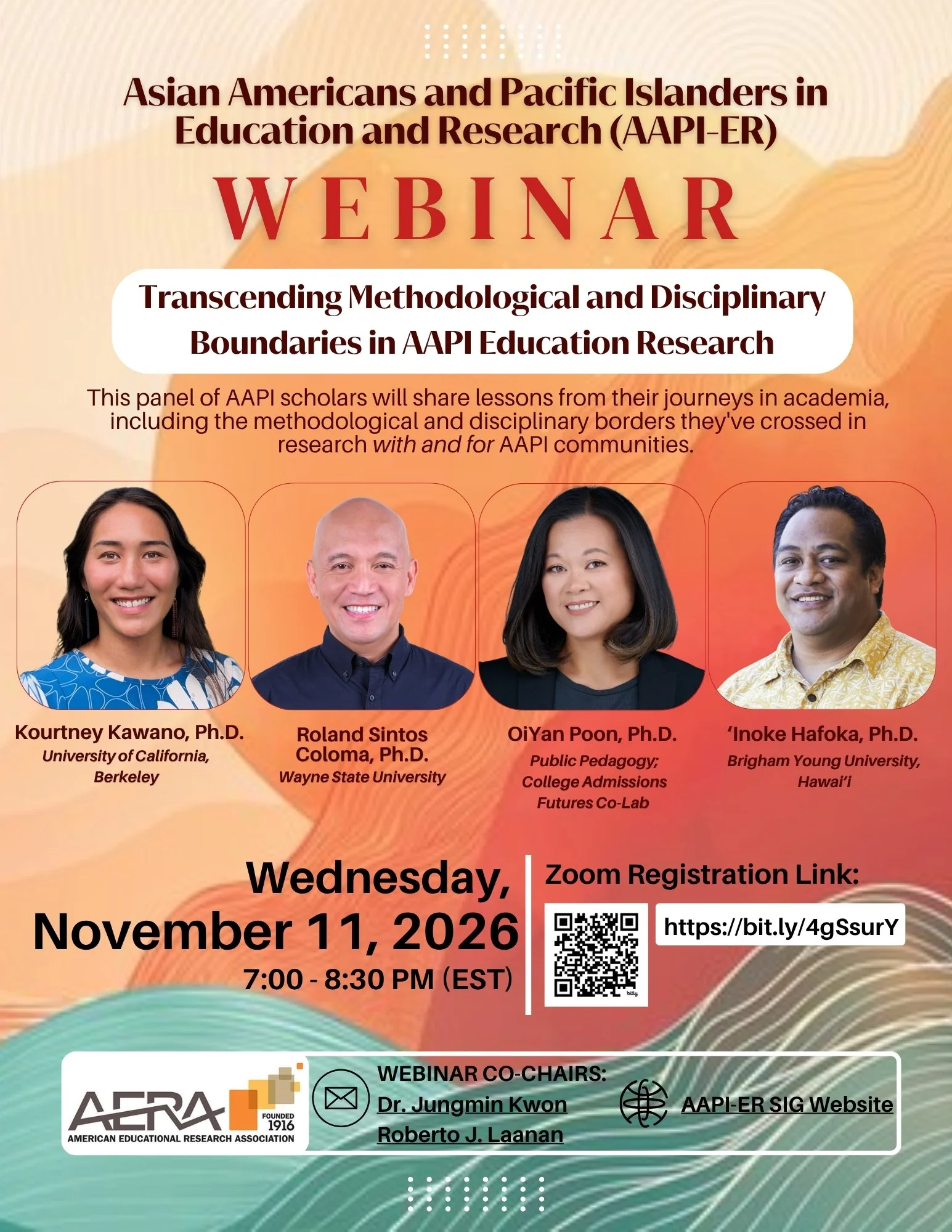
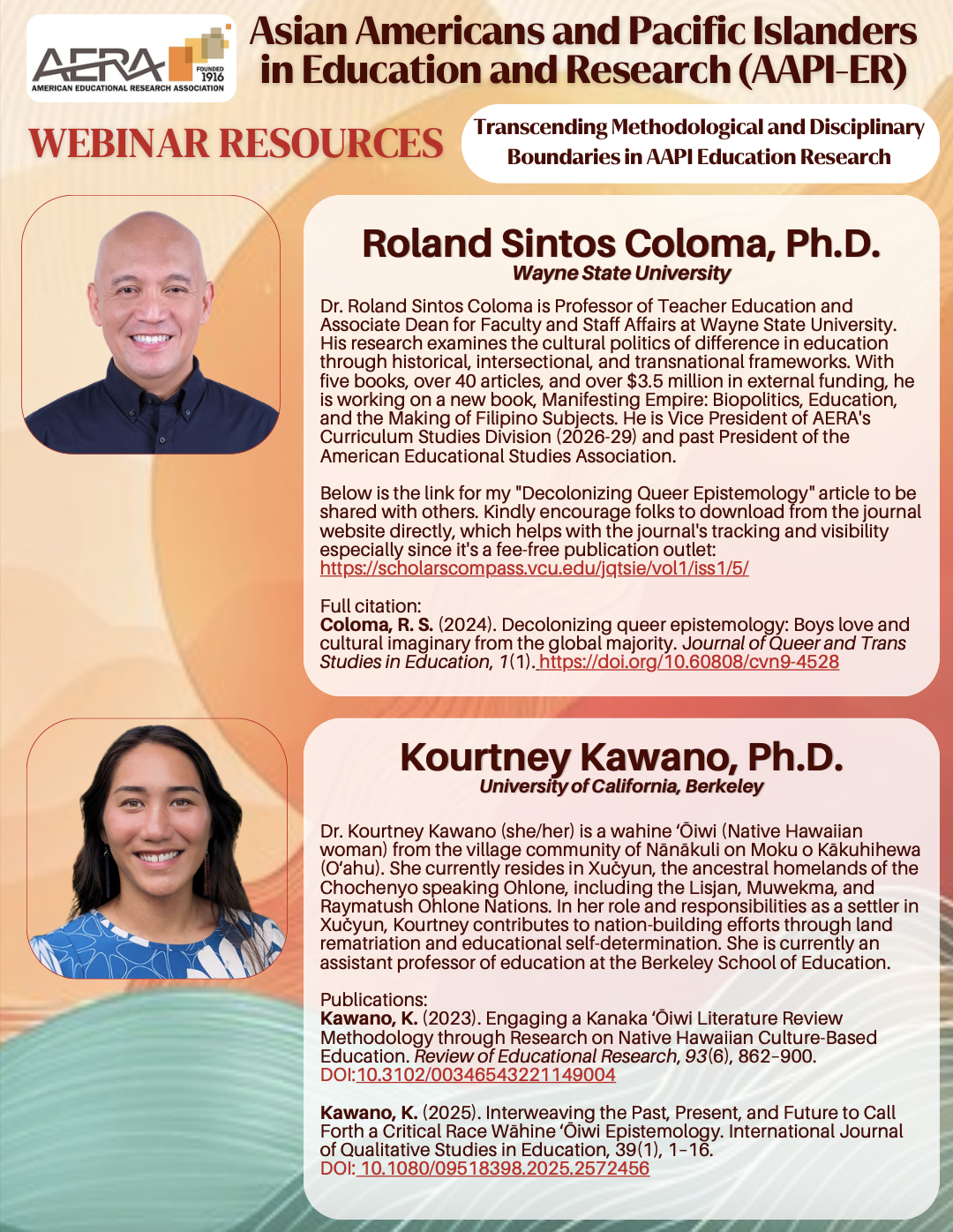
On Wednesday, November 11, I came together with Dr. Roland Sintos Coloma, Dr. OiYan Poon, and Dr. ‘Inoke Hafoka for a panel on transcending methodological and disciplinary boundaries in recognition of the 2027 theme for the upcoming American Educational Research Association meeting in the lands of the Missisaugas, Anishnaabeg, Chippewa, Haudenosaunee, and Wendat peoples. These are the guiding questions that oriented our individual remarks and our brief dialogue:
Tell us about your scholarly journey as an AAPI scholar.
Looking back on your research trajectory, what borders and boundaries have you crossed or challenged in your research with and for AAPI communities?
What methodological boundaries have you pushed in your own work? How has that boundary-crossing allowed you to center AAPI voices in your work?
How have you crossed disciplinary boundaries and what advice do you have for early career scholars who find themselves not fitting in one discipline or field or who seek to cross disciplinary boundaries?
What is one piece of advice you would give to graduate students and scholars in the Asian Americans and Pacific Islanders in Education and Research Special Interest Group?
As always, I led my remarks with Xučyun and Nānākuli as well as my ʻohana. I talked about my privilege and joy in being able to study family relations, Hawaiian culture-based education, and social change through an Indigenous and critical race theoretical perspective. What has stuck with me though as I find myself researching and writing about the field of education’s treatment of Pacific Islanders is how I have had to form relationalities with scholars in other disciplines in order to find relevant scholarship for our communities. In other words, I situate myself squarely in education, but I cross disciplinary borders to find Native Hawaiian-specific literature because my people’s knowledge systems have not yet been taken up in mainstream education research. I engage with anti-colonial work from Noelani Goodyear-Kaʻōpua, Manulani Aluli Meyer, Linda Tuhiwai Smith, Ananda Marin, Emma Elliott, and Meixi as well as critical feminist work from Haunani-Kay Trask, Nicole Alia Salis Reyes, Jamaica Heolimeleikalani Osorio, Kēhaulani Vaughn, and Maile Arvin, and these connections have helped sharpen my analysis and critique of the persistent legacy of the “AAPI” category.
To this end, crossing methodological and epistemological boundaries feels more like a euphemism for saying I do anti-colonial research and I have learned from my scholarly ancestors that I must center relationality with people and place over colonial disciplines that try to confine us to one mode of thinking and one intellectual tradition. For instance, as a graduate student, when tasked with conducting a systematic literature review, a historically individualist methodology without much relationality or accountability to the scholars of the research that is reviewed, I recognized that it is deeply antithetical to my understanding of Hawaiianness to conduct this research alone, to sever myself from my community. So, in this 2023 article that conceptualizes a Kanaka ʻŌiwi literature review methodology, I conducted talk-story interviews with the authors of the sources I reviewed and included their mana‘o, their insight, in my analytic process so that we might collectively advance a reading of self-determination and sovereignty in a Hawaiian culture-based education context for future researchers, teachers, and school leaders.
While I have found kinship with scholars who have been trained in different disciplines, I do not yet identify as an interdisciplinary scholar because I do not have a full understanding of Native and Indigenous Studies, Pacific Studies, or Asian American Studies, for example. Interdisciplinary scholarship is such a challenge, and for some early Pacific academics (i.e., Vicente Diaz, Haunani-Kay Trask, Teresia Teaiwa, ‘Epeli Hau‘ofa), thinking interdisciplinarily reflected their expansive, Indigenous philosophies. Today, the field of education is home to scholars trained in sociology, history, anthropology, linguistics, psychology, public policy, economics, political science, and more. I’m looking forward to deepening my relationship to my training in Critical Race Theory in Education and Indigenous epistemologies and learning how to translate my research to scholars in our multidisciplinary field.